
Rethinking the “One Wallet Fits All” Myth: a case study of Rabby for DeFi power users
Many DeFi users assume a wallet is just a key manager and UX wrapper — sign, send, repeat. That assumption understates how much wallet features shape risk, efficiency, and behavioral mistakes. Using Rabby Wallet as a concrete case, this piece explains the mechanisms that matter for advanced DeFi workflows: pre-signature simulation, approval management, multi-chain ergonomics, and institutional integrations. I’ll show where those mechanisms reduce real risks, where they stop short, and how to decide if Rabby’s trade-offs fit your use case in the US market.
The short version: Rabby is not a magic bullet, but it changes the decision surface. It puts simulation and scanning before signing — which reframes the wallet from passive vault to active gatekeeper — and combines that with broad EVM coverage, hardware wallet support, and enterprise hooks. Those features lower common attack vectors for DeFi power users, but they don’t eliminate systemic risks like smart-contract bugs, phishing, or the friction of custody policies. Read on for the mechanisms, the trade-offs, and practical heuristics for adoption.
How Rabby changes the signing decision: simulation and pre-transaction scanning
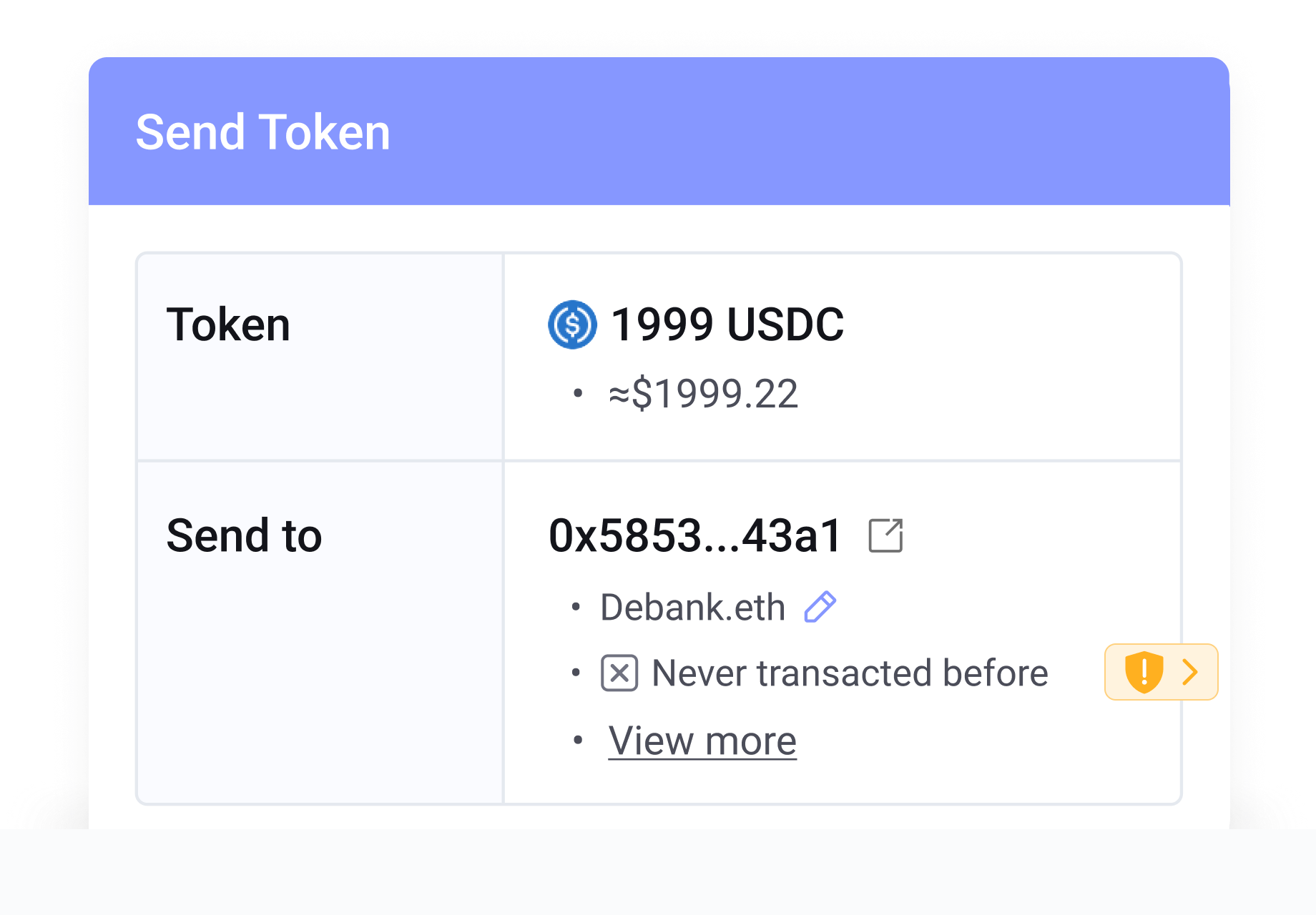
At the heart of Rabby’s user-facing differentiation is transaction simulation plus a pre-transaction risk scanner. Mechanically, simulation executes a transaction against a local or remote EVM fork (or a sandboxed view of the chain) to produce an estimated state delta: token moves, contract internal calls, and fee consumption. That output is translated into plain-language fields for the user: estimated balance changes, who receives funds, and the fee. Layered on top, the scanner flags suspicious inputs—previously exploited contracts, abnormal approval requests, or nonexistent recipients—before the user presses confirm.
Why that matters: “Blind signing” is the dominant human failure mode in DeFi. Most advanced exploits exploit cognitive shortcuts, whether a confusing permit flow, an overly broad ERC‑20 approval, or a disguised contract address. Simulation turns an implicit risk into explicit signals. It doesn’t make contracts safe, but it gives a user a chance to reject obviously anomalous state changes. For high-volume traders or active LPs who routinely sign many transactions, that warning layer materially reduces exposure to common automated scams.
Limitations and boundary conditions are important. Simulation is only as accurate as the node state and the fork model; it cannot predict off-chain oracle behavior or time-dependent variables outside the simulated block. A simulation can understate slippage in highly volatile pools or miss oracle manipulation vectors that require on-chain conditions to unfold after the simulated block. In short: simulation clarifies immediate effects, but it does not certify safety against complex, multi-step exploits.
Multi-chain ergonomics: automatic switching, cross-chain gas, and the visibility trade-off
Another practical constraint for DeFi power users is cognitive load: managing network settings, chain IDs, and gas tokens across many EVMs. Rabby automates network switching by detecting the dApp and switching your active chain automatically. It also supports cross-chain gas top-up so you can send gas tokens to an otherwise unfunded address on another chain. These features reduce friction and transaction failure rates — particularly useful for arbitrageurs, cross-chain strategists, and NFT collectors hopping between Layer 1 and L2.
But automation introduces a different risk surface: implicit trust in the wallet’s network-detection heuristics. If a malicious dApp spoofs metadata or if a browser extension interacts with an unexpected RPC, automatic switching could open subtle attacks. Practically, that means experienced users should pair Rabby’s convenience with habits: double-check the destination chain in the simulation output, and prefer hardware wallet signing for large-value operations.
Controls for exposure: approval revocation, hardware wallets, and multi-sig
Rabby includes a native approval revocation tool and broad hardware wallet compatibility (Ledger, Trezor, Keystone, and several more). For power users, being able to see all active token approvals and to revoke them natively is an operational improvement: it reduces long-lived exposure to compromised dApp contracts. Similarly, hardware-wallet signing reduces the chance that a compromised extension or OS keylogger can exfiltrate keys.
For institutional or shared-custody scenarios, Rabby’s integrations with Gnosis Safe, Fireblocks, and Cobo make it a fit for teams or funds that require multi-sig or enterprise custody. The trade-off here is orchestration complexity: multi-sig increases safety but slows throughput and requires policy design. Decide by expected transaction cadence and the minimum approval latency your strategies tolerate.
Where Rabby fits relative to alternatives, and what it does not do
Compared to mainstream alternatives (MetaMask, Trust Wallet, Coinbase Wallet), Rabby’s visible differentiators are the built-in simulation, the automatic network switching, and richer enterprise hooks. It’s open source under MIT, which supports external audits and community scrutiny — a governance-plus-transparency advantage for technically minded users. But Rabby lacks built-in fiat on-ramps and native staking within the wallet, which some users find inconvenient when they want a single app to do everything.
For more information, visit rabby wallet extension.
A notable historical event tempers confidence: in 2022 a smart contract associated with Rabby Swap was exploited for roughly $190,000. The team froze the contract, compensated users, and increased audits. That episode shows two things: first, even wallets with defensive features rely on external contract security; second, remediation is possible and the developers chose to compensate, which is a practical signal about operational maturity rather than a technical guarantee.
Decision framework: when to install Rabby and how to configure it
If you are a high-frequency DeFi trader, liquidity provider, cross-chain arbitrageur, or run an institutional fund, Rabby’s transaction simulation and approval tools lower specific operational risks. Use these heuristics when deciding:
- If you sign complex contract calls routinely and want a readable state delta before signing, Rabby’s simulation provides immediate value.
- If you manage assets across many EVM chains and want fewer manual network mistakes, the automatic switching and cross-chain gas top-up reduce friction.
- If you require enterprise integrations (Gnosis Safe, Fireblocks) or hardware-wallet-only signing, Rabby supports those workflows.
Configuration recommendations: pair Rabby with a hardware wallet for high-value ops; enable approval revocation as part of a weekly maintenance routine; inspect simulation outputs for recipient addresses and balance deltas rather than relying solely on textual labels; and keep an eye on RPC endpoints when using custom networks.
What to watch next
Three signals matter for the next 12–24 months. First, wider adoption of pre-signature simulation across wallets would lower industry-wide blind-signing risk — Rabby’s presence pushes that norm. Second, deeper integrations between wallets and oracle-safety services (to detect time-dependent manipulations) would address a current simulation blind spot. Third, regulatory trends in the US around custody and travel rules for keys could change the operational costs for enterprise integrations. Monitor those developments as they will affect both product design and operational compliance.
If you want to try Rabby from a pragmatic starting point, the browser extension is the fastest path to experience its simulation and approval tools; the project also provides mobile and desktop clients. For a direct install target and more product details, see the rabby wallet extension.
FAQ
Does transaction simulation make smart contracts safe?
No. Simulation reveals immediate state changes and fees for the simulated block, which helps avoid blind-signing and obviously malicious flows. It cannot predict complex, time-dependent exploits, off-chain oracle manipulation, or future contract upgrades. Treat it as a strong pre-signature filter, not a formal verification tool.
Can I use Rabby with a hardware wallet for maximum safety?
Yes. Rabby supports many hardware devices (Ledger, Trezor, Keystone, and others). Combining hardware signing with Rabby’s simulation and approval revocation gives layered protection: the key is stored offline while the wallet enforces pre-signature checks and visibility.
Is Rabby safe for institutional use?
Rabby integrates with multi-sig and enterprise custody providers (Gnosis Safe, Fireblocks, Amber, Cobo), which makes it suitable for many institutional workflows. But institutions must still design custody policies, approvals cadence, and incident response — the wallet provides tools, not governance by itself.
Bir Yorum Yazın